
Did Iran attempt a commerce raiding campaign in the Indian Ocean?
The IRIS Dena sinking

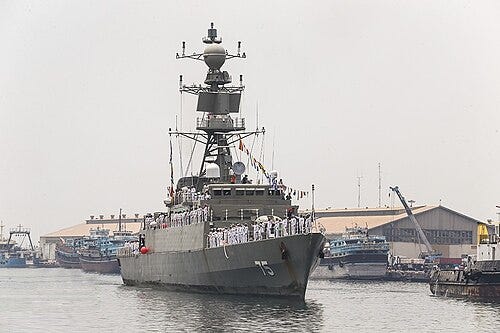
The strategic implications of a United States Navy Submarine, the USS Charlotte, sinking the Iranian frigate IRIS Iris Dena, are the focus of this brief article. [1]
Tactically, the sinking of the IRIS Dena was a straightforward task for the United States Navy’s submarine force. The Islamic Republic of Iran Navy’s (hereafter, Iranian Navy) neglect of anti-submarine warfare capabilities sealed that vessel’s fate.
The IRIS Dena is the second warship sunk by a nuclear-powered submarine. The first to share that fate was the Argentinian cruiser ARA Belgrano, sunk by HMS Conqueror during the Falklands War. [2] * Comparisons between the loss of the Belgrano and Iris Dena run into immediate difficulties based on their respective war zones.
The IRIS Dena was accounted for in international waters off Sri Lanka. However, in relative distance terms, the Belgrano was sunk much closer to the active warzone than Iris Dena was in proximity to the Gulf. So why did the United States Navy (hereafter USN) bother with the Iris Dena? That vessel was too far away from Iran and the Gulf to have any impact before getting sunk by coalition air strikes. The answer to that question lies in Iran’s reaction to the incident.
The remaining Iranian naval vessels sought shelter from a neutral Sri Lankan port. The Iranian Navy’s act of self-preservation is their reaction to recent events. [3] However, it’s not unheard of for a warship to seek the sanctuary of a neutral port. After the Battle of the River Plate, the German commerce raider Graf Spee sought shelter in the neutral zone/ Montevideo, Uruguay. Hans Langsdorff, the Graft Spee’s captain, opted to scuttle his damaged ship, rather than face additional combat against the Royal Navy.
Did the Iranian Navy attempt a commerce raiding campaign in the Indian Ocean?
At face value, the above question is absurd. The USN’s submarine force’s global presence, satellite coverage, and probable signals intelligence likely removed the present-day commerce raiding threat. *
However, I invite the reader to consider the following before dismissing the prospect of the Iranians aborting an Indian Ocean Raid. The loss of IRIS Dena and other Iranian naval vessels seeking neutral sanctuary might have halted that planned operation.
After the outbreak of war, insurance issues brought shipping in the Gulf to a halt. [4] Commerce raiders are the tool of the naval underdogs, and Iran fits that billing against the USN perfectly. Iranian surface raiders only needed to inflict enough damage to prevent shipping movements across the Indian and Pacific Oceans. Maritime insurance matters, and not ships lost, would have caused sea-based commerce to pause.
Such a development would have prevented Australia, New Zealand and other countries from importing fuel and other essential supplies.
References
[1]
https://www.charlotteobserver.com/news/nation-world/article314949686.html
[2]
http://news.bbc.co.uk/onthisday/hi/dates/stories/may/2/newsid_2480000/2480241.stm
*
How the Belgrano was outside the United Kingdom’s declared Exclusion Zone around the Falklands is omitted from this article for brevity’s sake. The controversy around that sinking occurred from people disconnected from military realities.
[3]
https://www.theguardian.com/world/2026/mar/05/iran-ship-sri-lanka-port-after-us-sinking-of-frigate
https://www.bbc.com/news/articles/c747vezn7zwo
*
German naval raiders operated globally in WW1 and WW2. The German Raider Atlantis is one example from 1940 -41.
https://www.usni.org/magazines/proceedings/1949/december/cruise-german-raider-atlantis-1940-1941
[4]
https://www.ft.com/content/865dab47-f9b8-4c81-88e6-15894cbda58c
Well done. I’m not sure why anyone would think negatively about us sinking that boat. Doesn’t matter where it is. When you go to destroy a military you sink their ships.
The wise move might have been to sit out the war at anchor in a neutral Sri Lankan or Indian harbour. That might have posed interesting dilemmas for the US.