
Book review: The Indian Caliphate: Exiled Ottomans and the Billionaire Prince
Book review

The Indian Caliphate: Exiled Ottomans and the Billionaire Prince. Imran Mulla. C. Hurst & Co (Publishers) Ltd.
Imran Mulla’s The Indian Caliphate: Exiled Ottomans and the Billionaire Prince offers a glimpse of the Caliphate’s fate and failed resurrection. [1]
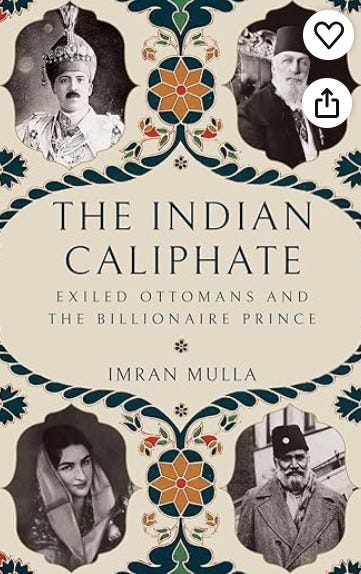
The Indian Caliphate: Exiled Ottomans and the Billionaire Prince (hereafter, The Exiled) provides a historical roller-coaster ride for historical propagandists. For the reader, that wild ride begins with Prince Abdulmejid caught up in Ottoman Empire turmoil. Abdulmejid’s father, Sultan Abdulaziz, was overthrown by the Young Turks in a coup. [2]
Note to the reader: This reviewer has opted to retain Mulla’s spelling in The Exiled.
Notably, The House of Osman fused the Ottomans with the Caliphate. [3] Ottoman rulers turned to “friendly philosophers” for that fusion and to turn the Caliphate away from Sunni influence. [4] The geographical influence of the reinvented Islamic institution reached the subcontinent. However, the [Islamic] Mughal Empire paid token loyalty to the Caliphate’s leaders and global sovereignty claims.
The Exiled’s opening act provides a solid grounding for the reader. For the reader, that grounded approach outlines WW1’s end, the Ottoman Empire’s demise, and Mustafa Kemal Pasha founding modern-day Turkey. * [5]If someone is new to military history, sufficient background information about those matters is provided until the solid ground cracks.
Abulmejid joined a roller coaster ride after Turkey outlawed the Caliphate in March 1924. [6] His attempts to resurrect the Caliphate are the ride’s ups and downs. Abulmejid’s exile from Turkey represented his launch pad and traumatic displacement. [7]
Mulla displays a talent for gross understatement: His overview of Indians’ opposition to the United Kingdom breaking their wartime promise to protect the Caliphate is telling. The emergence of civil en masse disobedience crossed communal lines, temporarily unifying Hindus and Muslims. [8] While communal divides returned, nationalism remained ingrained.
Mulla’s focus shifts to the Middle East and India, introducing new players to the reader. His Exalted Highness – the Nizam of Hyderabad, a prince, takes centre stage. Osman Ali Khan, the Nizam, ruled a thriving and cosmopolitan Hyderabad. [9]
The Nizam was eccentric and austere. [10] His stingy nature sat alongside marble halls, wonderful fabrics, fine dining and enormous wealth. That wealth wasn’t on Wall Street, but from gold, diamonds and rubies. [11] Culturally, he was knee-deep in Urdu poetry and was his region’s ambassador for that literature. [12]
Urdu’s role in British India is tackled in the Reviewer’s Note below. Readers with expertise in that matter are free to leave a comment below.
Khan opted to support Abulmejid financially. Curiously, he opted to express that support via poetry. [13] Historically, this is where Abulmejid’s roller coaster first slows down. In daily life terms, this meant his family managed to live on the French Riviera. [14]
Moreover, the reader’s experience doesn’t match the Riviera. Mulla doesn’t elaborate upon Khan’s character to explain why he communicates via poetry. Readers are left without the depth behind his personality. Those missing attributes unlock a window into how and why historical figures operated.
The Exiled’s middle section is where Mulla’s work joins its wild ride. At 284 pages, he was left with scope for expanding upon his narrative. That is shown by The Exiled’s coverage of the political struggle/violence in Palestine. That is where his brief overview of Mufti Haj Amin al-Hussani matters.
Mulla treats Hussani as someone who deserted the British for fascism. [15] The danger is that the reader mistakes that undercooked explanation as a justification for Hussani’s actions. Building upon that assessment would have provided the reader with additional information for consideration.
Mulla links the World Islamic Congress (hereafter Congress) to the Palestinian cause. The 1931 Congress was held in Jerusalem. [16] The attendees, including Hussani, rallied against the Jewish presence in Palestine. [17]
The author’s analysis of the Congress’s historical legacy contains two crucial elements. First, Palestine is no longer an Arab and Jewish conflict. Global Islam is linked to the perceived Arab struggle in that region. Second, those links remained in place in the post-war period. [18]
Mulla’s argument about the origins of Palestinian identity rests in the 1930s. The risk is leaving the impression that his case relies on the Palestine issue remaining unchanged. That notion would undercut his argument. Palestine was the geographical area covered by the League of Nations mandate.
The Israeli occupation of Gaza and the West Bank, after the Six-Day War, is when the Palestine matters reemerge. Why those matters vanished between the creation of the state of Israel and the Six-Day War is the crux of that matter. The reader is best left to ponder that matter. *
Moreover, The Exiled’s journey finishes on a deathly tone. Abulmejid faced the German occupation of France, before dying in 1944. [19] His death ended his roller-coaster ride without influencing history in his favour.
Hyderabad’s opportunity for autonomy died with India’s independence/partition. Like the rest of India, Hyderabad was overrun by blood-stained communalism. However, Jawaharlal Nehru’s government employed military force to absorb Hyderabad into the Indian state. The Nizam turned down the opportunity for Hyderabad to join Pakistan. [20]
The defunct Ottoman Empire Caliphate never assumed a position of power in the post-war world. Mulla’s outlines of those grave ends return The Exiled to its heights. Abulmejid and Hyderabad’s fates are covered in a solid and informative manner.
However, diagrams/family trees documenting Abulmejid and the other players are missing. Maps covering the subcontinent and the Middle East are also absent. Readers are robbed of handy reference points by those omissions.
Ironically, like Mulla’s source material, The Exiled is a roller coaster. For the reader, with existing historical knowledge, to paper over the low points, there is ample value in The Exiled. The same applies to the reader who is willing to undertake future research about the topics Mulla underdoes. Moreover, The Exiled is unsuitable as a standalone reference title or for someone new to 20th-century history.
References
[1]
Imran Mulla:
His X account:
The Indian Caliphate: Exiled Ottomans and the Billionaire Prince.
https://www.amazon.com.au/Indian-Caliphate-Exiled-Ottomans-Billionaire/dp/1805264249
[2]
The Indian Caliphate: Exiled Ottomans and the Billionaire Prince. Imran Mulla. C. Hurst & Co (Publishers) Ltd. P10
[3]
The Indian Caliphate: Exiled Ottomans and the Billionaire Prince. Imran Mulla. C. Hurst & Co (Publishers) Ltd. P16
[4]
ibid
*
Pasha became known as Ataturk, Father of the Turks.
[5]
ibid, P47, 49, 70, 74, 79- 82
[6]
ibid, 89
[7]
ibid, P89- 94
[8]
A brief introduction to the history behind Indian communalism.
https://ijssrr.com/journal/article/view/2273/1717 (PDF download.)
Reviewer’s Note
Urdu was the working language employed by the British in India. British Indian Army Officers and members of the Indian Civil Service employed that language in a ruling-class manner. Grammatically incorrect writing and condescending verbal instructions were hallmarks of that rude manner.
See: https://pu.edu.pk/images/journal/studies/PDF-FILES/Tariq-2%20new.pdf
However, General William Slim, the commander of the Fourteenth Army, was able to address his troops in multiple Indian languages fluently. One of Slim’s contemporaries, Lieutenant-General Francis Tuker, spoke those languages well enough to interact with the local art scene.
Between Slim, Tuker, and imperial rule’s norms, is someone’s character and time spent in India.
See:
Slim’s Defeat Into Victory: Battling Japan in Burma and India, 1942-1945
https://www.amazon.com.au/Defeat-Into-Victory-William-Slim/dp/0815410220
Tuker’s While Memory Serves
https://dn760003.eu.archive.org/0/items/1950-while-memory-serves-by-tuker/1950%20While%20Memory%20Serves%20by%20Tuker.pdf (PDF download).
[9]
The Indian Caliphate: Exiled Ottomans and the Billionaire Prince. Imran Mulla. C. Hurst & Co (Publishers) Ltd. P109.
[10]
ibid, P117 – 118
[11]
ibid, 117
[12]
A sample of Urdu poetry
Urdu poetry gatherings (Mushaira)
https://rekhtalearning.com/blog/mushaira-a-history-of-thunderous-and-traditional-w/
The Indian Caliphate: Exiled Ottomans and the Billionaire Prince. Imran Mulla. C. Hurst & Co (Publishers) Ltd. P125 – 27
[13]
ibid. 126-27
[14]
ibid, 129 – 32
[15]
ibid, 142
[16]
ibid, 169
[17]
ibid, 172
[18]
ibid
*
This reviewer recommends Professor Jean-Pierre Filiu’s A History of Gaza. Filiu’s title covers Gaza’s post-war history. He covers Gaza’s time under Egyptian and Israeli control on a fair basis. This reviewer hasn’t come across a similar title covering the West Bank.
https://www.amazon.com.au/Gaza-History-Jean-pierre-Filiu/dp/0190201894
[19]
ibid, 192-93
[20]
ibid, 207-9
Interesting. The Nizam's last days in 1947 are however remembered for the tragic killings engaged in by his secret police " The Razakars". Unfortunately most Western historiography doesn't dwell on this. Like the treatment of the 1946 Calcutta Riots, my research for an upcoming book shows these silences to be unfortunate for a Rankean and non " Project" history of the era.