
Book Review: Ring of Fire
Book review

Ring of Fire: A New Global History of the Outbreak of the First World War. Alexandra Churchill and Nicolai Eberholst, Head of Zeus, 2025.
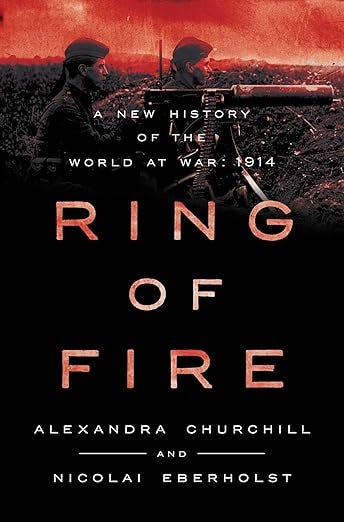
Alexandra Churchill and Nicolai Eberholst’s Ring of Fire: A New Global History of the Outbreak of the First World War captures that conflict’s outbreak from eyewitness accounts. Those accounts (hereafter snapshots), along with Churchill and Eberholst’s narration, follow the fallout from war unleashed in chronological order.
Churchill and Eberholst’s (hereafter the authors) narration is structured around snapshots and unfolds with evolving events. How matters unfold across a historical timeline is unusual compared to titles that extensively examine battles and campaigns. Ring of Fire’s geographical and topical focuses differ from chapter to chapter.
Ring of Fire’s window into WW1’s opening serves as the foundation for the snapshots illustrating unseen perspectives and overlooked events. The snapshots form a dense forest consisting of overlooked perspectives and events.
Subject to their existing knowledge, readers will find new paths/topics, for additional reading. Ring of Fire provides reference points that smash historical silos. Put another way, the reader is presented with the opportunity to connect Australia and New Zealand’s colonial period with WW1. [2] Trans – Tasman history between European settlement and WW1 is interconnected, not stand-alone incidents.
Ring of Fire covers how neutral countries fared on the sidelines. The authors demonstrate how neutrality wasn’t a shield against the tsunami of ripple effects from the war’s outbreak. One notable impact of the surging tides was that global commerce came to a halt.
Ships owned by United Kingdom shipping companies were recalled for wartime service. Additionally, a comfortable majority of Cunard’s deck officers were commissioned in the Royal Navy Reserve. [3]
South American countries’ access to international export markets was terminated by the massive chunk of the United Kingdom/ global shipping no longer in civilian service. In one instance, Argentinian sugar and coffee were rotting in harbours by 1914’s end. [4]
The reader is presented with the opportunity to learn more about why armies commit atrocities without condoning those morally abhorrent acts. * Ring of Fire’s forest includes snapshots of war crimes, including the German Rape of Belgium. [5] The backbone behind those bloody snapshots is the author’s explanation of the inexcusable rationale behind those acts.
Among the blood-stained trees are the lesser-known atrocities undertaken by Russian and Austrian-Hungarian troops. Russian soldiers executed German civilians who owned bicycles. Since everyday Russians didn’t own bicycles, it was assumed any person who had access to one was guilty of espionage. The same fate awaited East Prussian civilians who used barbed wire fencing. The Russians associated barbed wire with anti- calvary measures. [6]
The Russian ground forces caught up in “bicycle and barbed wire” mania symbolise armies with a warped moral code and world views.
Ring of Fire debunks two long-standing WW1 narratives. First, the early stages of the war and emerging battlefields – European confinement is a myth. In debunking that myth, the authors cover China, Africa, Japan, and the Pacific. Japan’s entry into the conflict is relatively unknown in the Anglosphere, in particular.
Japan’s offensive against German interests in Tsingtao, China, illustrates the spillover from seemingly unrelated events in Europe and the Balkans. Japan exploited the unfolding situation to expand its allies, and their British Allies, despite any reservations, couldn’t object. [7]
Compared to Japan’s actions, Australia’s seizure of German New Guinea and New Zealand’s capture of Samoa are under-documented but better known. [8]
The trees in Ring of Fire’s forest fall in one aspect. The author’s argument that the Ottoman Empire and Italy entered the war for imperial territorial gain is fragmented. The authors put the horse before the cart, and that risks the reader abandoning that notion. * However, if the reader puts aside that fractured element, Ring of Fire’s ecosystem remains intact.
The authors introduce the reader to how senior military commanders viewed events. When matters took a turn for the worse, battlefield reversals elsewhere failed to relieve the pressure valve. Alternatively, how Generals cope with adversity and ailing fortunes across separate geographical regions in Ring of Fire’s timeline is understated. This recasts the Battle of Tannenberg and the simultaneous German pressure on French forces in a new light for the reader.
Ring of Fire’s forest grows from the authors’ focus on WW1’s ballooning outbreak. For the reader who is new to military history, Ring of Fire provides a framework for their learning journey. The emerging Western, Eastern, and other theatres of war, and “neutral countries,” are part of that historical forest’s ecosystem.
For the long-term WW1 students, Ring of Fire provides a global interconnected perspective. When they opt to read titles that offer in–depth analysis of a battle or campaign, it is possible to marry that assessment with Ring of Fire’s forest.
References
[1]
Ring of Fire: A New Global History of the Outbreak of the First World War
https://www.amazon.com.au/Ring-Fire-History-World-1914/dp/1639369279
Alexandra Churchill:
Her website:
https://www.alexchurchill.co.uk/
Her Bluesky:
https://bsky.app/profile/alexchurchill.bsky.social
Her Instagram:
https://www.instagram.com/churchill_alex/
Nicolai Eberholst:
His X:
His Instagram:
https://www.instagram.com/pikegrey1418/
[2]
Australia’s colonial period, 1788 – 1901
https://www.awm.gov.au/articles/atwar/colonial
New Zealand’s colonial period has a less clear-cut time frame.
https://nzhistory.govt.nz/page/history-new-zealand-1769-1914
Also see:
Ring of Fire: A New Global History of the Outbreak of the First World War. Alexandra Churchill and Nicolai Eberholst, Head of Zeus, 2025, pp. 67 – 68
[3]
ibid, 213-14
[4]
ibid 223
*
How this review addresses Ring of Fire’s focus on atrocities reflects positively on the authors. However, given the inherently dark moral character of war crimes, he takes an unusual amount of care when covering them.
[5]
ibid 172 – 175
[6]
ibid 173 – 74
[7]
https://www.nam.ac.uk/explore/siege-tsingtao
Ring of Fire: A New Global History of the Outbreak of the First World War. Alexandra Churchill and Nicolai Eberholst, Head of Zeus, 2025, pp. 324 - 332
[8]
ibid 316- 24
*
This reviewer doesn’t invalidate the authors’ conclusions, but assesses the structure of those arguments and how they link to the conclusions.