
Book Review: Orchestrating Power
Book review: Orchestrating Power: The American Associational State in the First World War.

Orchestrating Power: The American Associational State in the First World War. Nathan K. Finney. Cornell University, 2025.
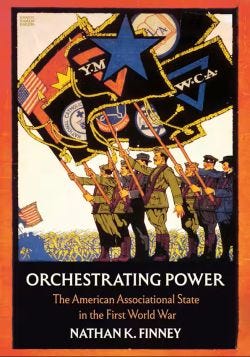
Nathan K Finney, the soldier-scholar, is an emerging authority on strategy, the military profession, and niche military history topics. His previous books are On Strategy: A Primer and Redefining the Modern Military: The Intersection of Profession and Ethics (co-authored with Tyrell O. Mayfield). Orchestrating Power is his latest and welcome topical addition to his previous works. [1]
Finney’s Orchestrating Power captures the North Carolina Council of Defense, which enabled the war effort through military and societal mobilisation. That Council of Defense (hereafter Defence Council), other unofficial and blatant role was to maintain that state’s white supremacist status quo. [2]
Orchestrating Power begins with the U.S. entry into WW1. The Woodrow Wilson administration, implementing the Defence Council’s structure, navigated federalism and political wrestling with Congress. Despite the Defence Councils operating at the state level, their birth is from the National Council of National Defense (hereafter the National Council). The National Council consisted of an executive/decision-making and advisory branches.
The Associational State is formed by delegating authority to politically acceptable institutions. Those bodies adapt public policy and balance out competing interests and opportunities. [3]
The Defence Council acted as an intermediary between the state government, Washington D.C, the private sector, African American, and women’s groups. It was in those roles that the Defence Council met the criteria for the Associational State (hereafter, coordinating body or similar).
Orchestrating Power’s narrow focus is on the Defence Council’s role as a wartime coordinating organisation. Finney’s essay writing style provides readers with consistent conclusions throughout and at the end of chapters. These historically accurate points support Finney’s Defence Council analysis.
Beyond the North Carolina racist and elitist rule, Finney doesn’t sufficiently describe the often-mentioned historical figures. Thomas Bickett, the North Carolina governor, is central to events. Bickett’s character’s impact on the Defence Council and his state’s politics is inseparable from the historical record. *
Numerous Defence Council committees and sub-committees addressed an array of pressing issues. Orchestrating Power desperately required diagrams and charts displaying those committee’s details. Those visual tools would have made it easier for the reader to record those committee members. The same applies to the people who exercised Power by appointing committee members.
The Defence Council emerges as an open toolbox intended to address a range of wartime demands. Finney shows how the best tools are open to misuse, and without any disguise. The Defence Council abused its powers to address peacetime issues that threatened the North Carolina Empire. *
The Defence Council actively undermined efforts to improve African American and Women’s rights and social mobility. In one instance, support for “anti- vagrancy” laws and other measures to ensure African Americans remained in farm work is an instance where the establishment manipulated the system in their favour. African Americans fled North Carolina for better-paying jobs and more freedom in other states before the U.S’s late WW1 arrival.
Orchestrating Power’s unspoken strength is demonstrating the Defence Council’s successful disingenuous double act, which lasted until the armistice: The Defence Council organised North Carolina’s mobilisation of people and resources for that state’s contribution to the war effort. However, the Defence Council also worked the levers of Power to maintain the North Carolinian Empire.
Orchestrating Power provides solid research and reference material on the Defence Council’s short yet impactful methods behind North Carolina’s contribution to the U.S. war effort. The snapshot of the North Carolinian Empire double act is an intriguing glimpse into a society grappling with wartime demands and the resulting strains.
References
[1]
Nathan K. Finney
His website:
https://nathankfinney.com/
His Bluesky:
https://bsky.app/profile/nathankfinney.com
On Strategy: A Primer
https://www.armyupress.army.mil/Portals/7/combat-studies-institute/csi-books/on-strategy-a-primer.pdf (PDF Download)
Redefining the Modern Military: The Intersection of Profession and Ethics
https://www.amazon.com.au/Redefining-Modern-Military-Intersection-Profession/dp/1682473635
[2]
A broader look at Jim Crow laws:
https://www.pbs.org/wgbh/americanexperience/features/freedom-riders-jim-crow-laws/
Background on African Americans falling victim to lynchings:
https://www.pbs.org/wgbh/americanexperience/features/emmett-lynching-america/
For North Carolina’s One Party Democratic Party post-reconstruction 1877 and post–coup 1898 rule, see:
Orchestrating Power: The American Associational State in the First World War. Nathan K. Finney. Cornell University, 2025. P 25- 26
[3]
ibid, P4
*
North Carolina’s constitutional arrangements were an outlier, with the executive branch blended with a Westminster-style cabinet. Unlike other state governors, Bickett lacked the Power to veto bills passed by the state legislature.
ibid, P26
*
The North Carolinian Empire is this reviewer’s term for Finney’s description of North Carolina’s white supremacy - morally repugnant, elitist, paternalistic racism and agricultural-based social and economic order. This reviewer noticed the overlap between Finney’s assessment and the European colonial order.
Finney’s original outline of North Carolinian society and economy:
ibid, p26 – 27.